
Custom integration scenarios
As discussed in previous chapters, the EpisXperience platform offers a robust suite of APIs designed to facilitate seamless integration with your existing information ecosystem. These APIs serve as the primary means of connectivity, ensuring smooth data exchange and interoperability.
Beyond standard API integrations, we support custom integration approaches tailored to your organization's unique requirements. One such approach is Kafka-based integration, which enables efficient, real-time communication between various systems and applications.
Integration using Kafka
The EpisXperience platform is built on a microservices architecture, where independent microservices interact via the Kafka messaging bus. This architecture ensures scalability, flexibility, and fault tolerance in handling high-volume data streams.
By exposing Kafka to external applications, we allow those applications to produce events and send them to the Kafka bus directly. This enables event-driven communication and facilitates real-time data processing.
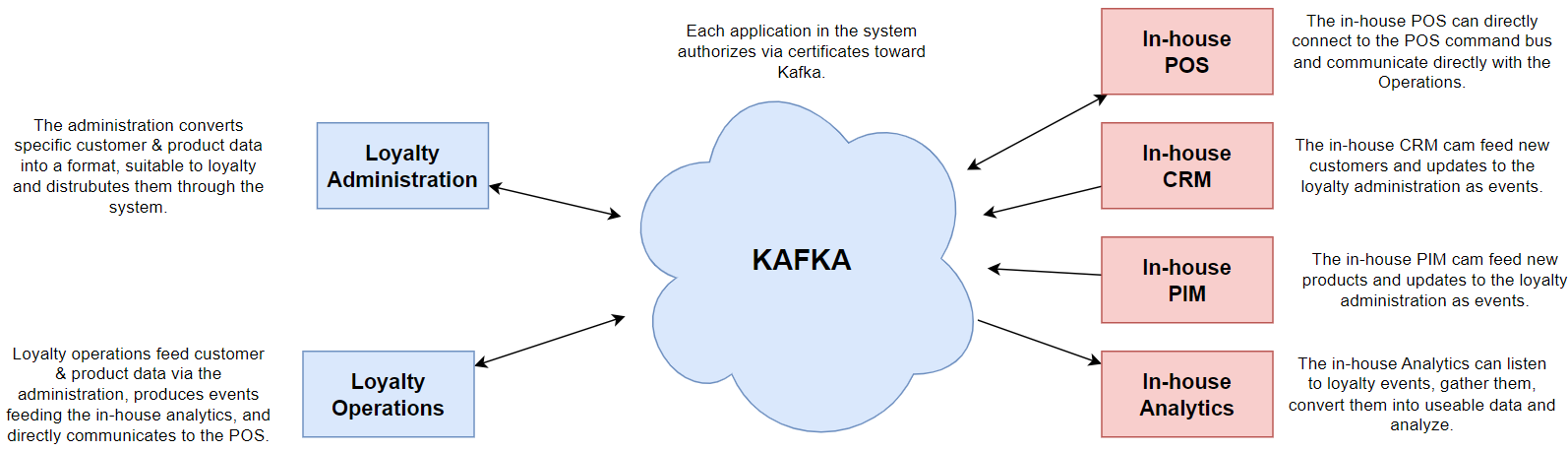
A Kafka-based integration can enhance operational efficiency across multiple internal systems. Below are key examples of how different in-house applications can interact with Kafka:
In-house POS (Point-of-Sale System): The POS system can connect directly to the POS command bus, enabling real-time communication with operational services to process transactions seamlessly.
In-house CRM (Customer Relationship Management): The CRM system can publish customer-related events, such as new customer registrations and loyalty program updates, ensuring real-time synchronization with the loyalty administration.
In-house PIM (Product Information Management): The PIM system can push updates related to new products and pricing changes as events, ensuring the loyalty administration reflects the latest product catalogue.
In-house Analytics: The analytics system can subscribe to loyalty events, collect and process data, and generate insights for business intelligence and decision-making.
By integrating with Kafka, organizations can achieve real-time data synchronization, enhance automation, and improve overall system efficiency. This event-driven approach ensures that business processes remain responsive and agile in a dynamic environment.
Example
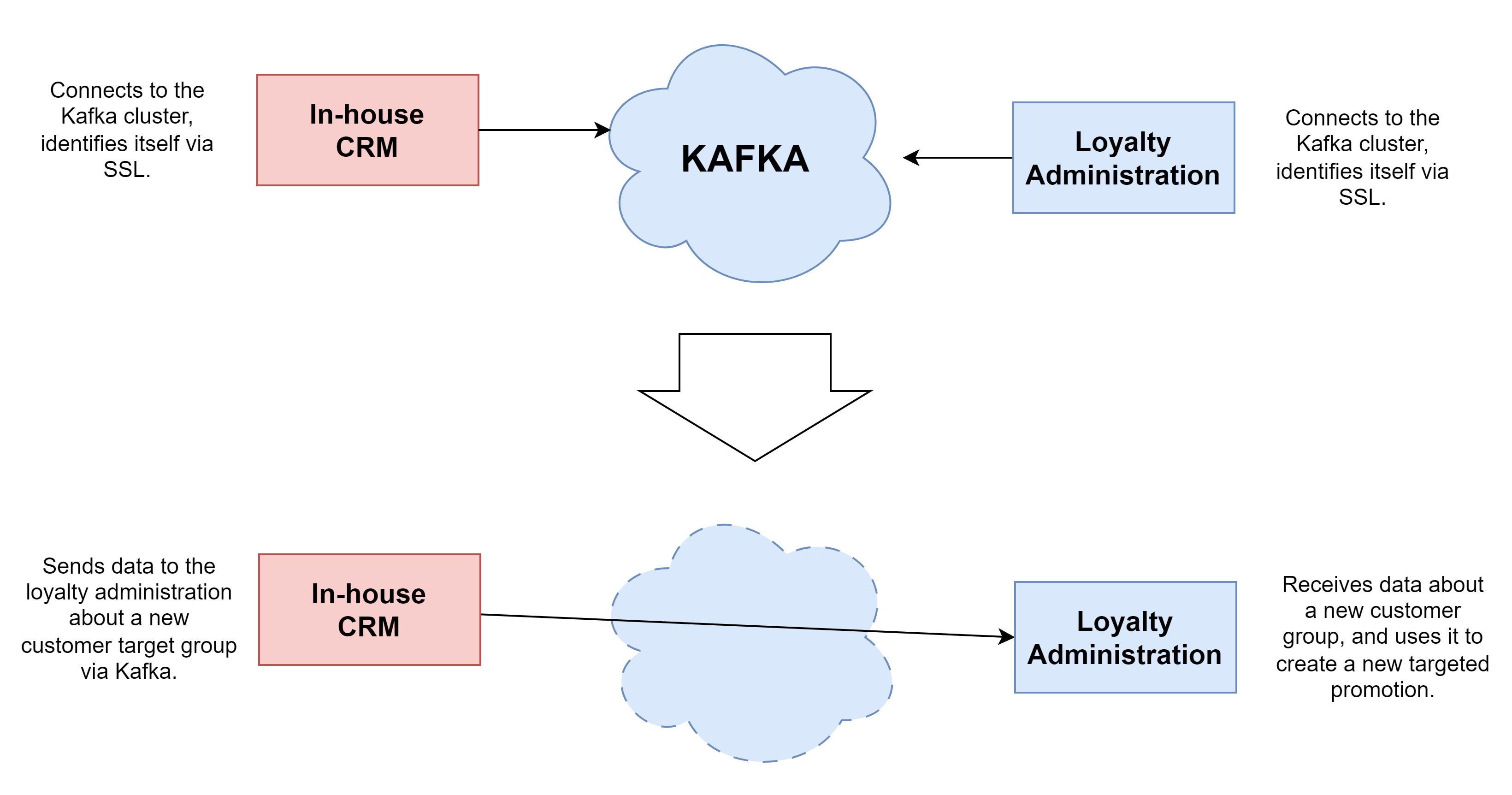
As an example, an in-house CRM can login to the loyalty system’s Kafka cluster using standard SSL authentication via a certificate, authenticating it as a participant in the data exchange, allowing it to send a newly created target group for a promotion to the loyalty system via its administration module. From there a new promotion can be created, for which members of the target group are eligible.